

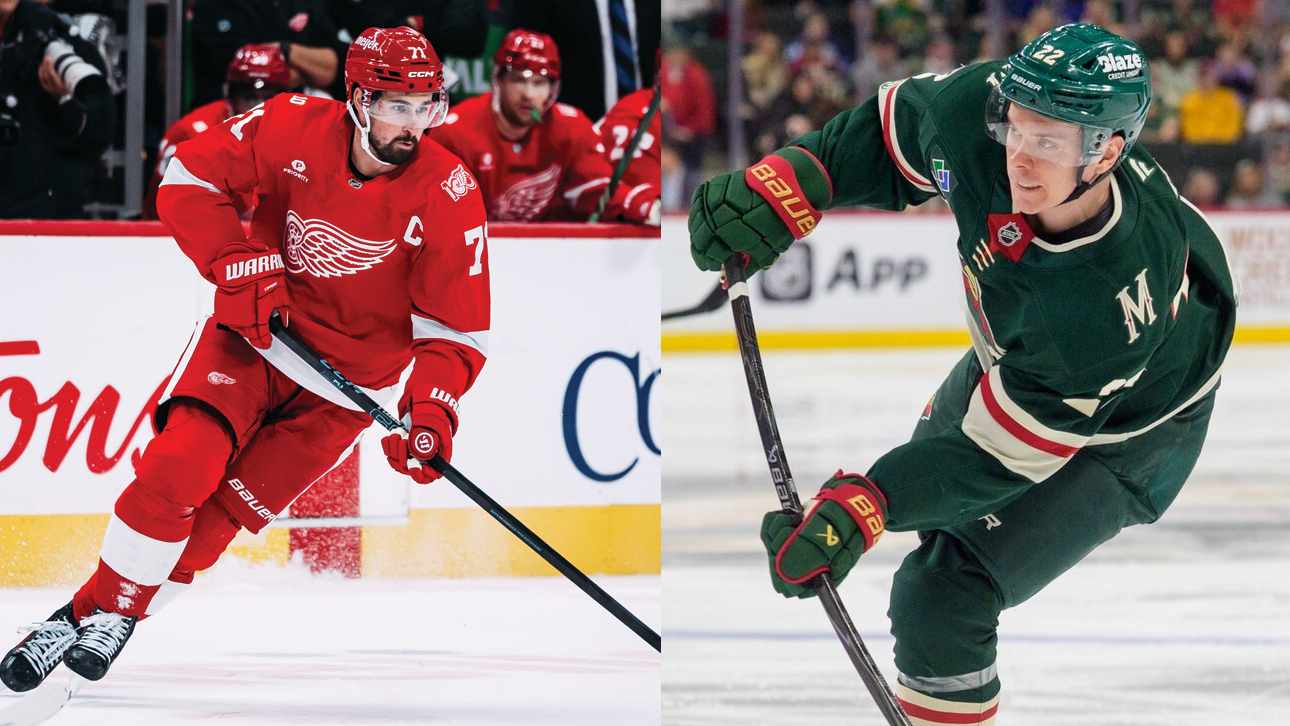
The Detroit Red Wings have a Dylan Larkin problem, and the Minnesota Wild may have just discovered how difficult it will be to solve.
After months of trade speculation, Minnesota remains one of the most intriguing destinations for Detroit’s former captain. But the latest reporting suggests the two teams are struggling to agree on the value of 22-year-old forward Danila Yurov, a player the Wild reportedly view as a major piece of a potential trade package.
That disagreement could determine whether Larkin ends up wearing a Minnesota Wild jersey or whether Detroit looks elsewhere for a better return.
According to NHL insiders Elliotte Friedman and Frank Seravalli, the Red Wings haven’t been convinced by the framework Minnesota has explored. And with Larkin expanding his list of acceptable destinations, the Wild no longer have the same negotiating advantage they enjoyed earlier this year.
The biggest question isn’t whether Minnesota wants Dylan Larkin. It’s whether the Wild can afford to give Detroit what it actually wants.
Here’s what the latest NHL trade rumors reveal, why Yurov has become such an important name, and where I believe the negotiations could go next.
What NHL Insiders Are Reporting About Dylan Larkin and the Minnesota Wild
The latest developments help explain why a Dylan Larkin trade has yet to materialize.
Enjoying our trade coverage? Add us as a preferred source on Google to catch breaking rumors first.
During an appearance on NHL Network, Sportsnet insider Elliotte Friedman discussed Minnesota’s pursuit and described a potential package involving Danila Yurov, draft picks and possibly another player. His understanding was that the framework hadn’t been enough to convince Detroit.
Frank Seravalli provided additional context during an appearance on Flames Now, explaining that the Red Wings were not particularly enthusiastic about Yurov serving as a centerpiece.
That’s a significant distinction.
It doesn’t necessarily mean Detroit considers Yurov a bad player. It means Minnesota and Detroit may have different projections for what the young forward will become.
Friedman also reported on 32 Thoughts that Detroit has been exploring young centers and high-end prospects as possible returns in its trade discussions.
That suggests the Red Wings want a player capable of becoming part of their next competitive core rather than simply collecting draft picks.
Importantly, these are reported discussions and proposed frameworks. No finalized offer sheet or completed trade package has been publicly confirmed.
Why Danila Yurov Has Become the Biggest Obstacle
Yurov is one of the more fascinating players involved in the current NHL trade rumor market.
Selected 24th overall in the 2022 NHL Draft, the Russian forward possesses offensive creativity, good puck skills and the potential to develop into a dependable NHL center.
His early-season production has been encouraging.
Through 11 games, Yurov had recorded four goals and five points, an improvement in scoring pace over the 27 points he registered in 73 games during his rookie season.
But there’s a difference between showing promise and demonstrating that you’re ready to replace a proven first-line center.
Larkin has delivered five consecutive 30-goal seasons. He’s an established two-way forward who can play significant minutes, contribute in all situations, and provide leadership in a demanding market.
Yurov hasn’t established that same level of reliability.
From Detroit’s perspective, the concern may be relatively simple: What happens if Yurov becomes a good middle-six forward rather than an elite top-six center?
For the Wild, that same uncertainty creates potential value. Yurov’s development could make him an outstanding long-term asset, particularly given his inexpensive contract.
Both front offices can look at the same player and arrive at dramatically different conclusions.
And right now, that difference appears to be holding up a possible blockbuster.
Is Danila Yurov Enough to Land Dylan Larkin?
A look at Yurov’s development and how three hypothetical returns fit Detroit’s priorities.
2025–26: 27 in 73 games
2026–27: 5 in 11 games*
A. Yurov + two draft picks
Future upside, but limited proven top-six replacement value.
B. Yurov + NHL forward + first-round pick
More immediate help, but still significant uncertainty at center.
C. Young top-six center + top prospect + first
Best aligned with Detroit’s reported desire for young, high-impact talent.
The Detroit Red Wings Can’t Afford to Lose Another Franchise Cornerstone for Too Little
Here’s where I believe Detroit needs to be particularly careful. Trading Dylan Larkin isn’t simply moving an expensive veteran to accelerate a rebuild. You’re potentially moving a player who represents more than a decade of the organization’s identity.
Larkin grew up in Michigan, developed into an NHL star with his hometown franchise, and spent years carrying enormous expectations.
His departure would create another major question for an organization already dealing with significant uncertainty.
Steve Yzerman’s departure from the general manager position, Shawn Horcoff’s interim leadership role, and the ongoing questions surrounding the Red Wings’ direction have made this a sensitive period.
Detroit needs meaningful assets coming back. And there’s another issue.
If the Red Wings receive several prospects without someone capable of immediately handling important NHL minutes, they risk making an already difficult season even harder.
I’ve always believed that when trading a legitimate top-line center, the most dangerous mistake is confusing the number of assets received with the quality of those assets.
Four average pieces don’t necessarily equal one exceptional player. If Detroit moves Larkin, the return needs to establish a foundation for the next several seasons.
Why the Minnesota Wild Still Make Sense for Dylan Larkin
Despite the complications, Minnesota remains a logical destination. General manager Bill Guerin has assembled a competitive roster featuring Kirill Kaprizov, Matt Boldy, Joel Eriksson Ek and Quinn Hughes.
What makes Larkin appealing is his ability to strengthen the center position without requiring the Wild to gamble on an unproven player.
Imagine Larkin driving a scoring line while Eriksson Ek continues handling difficult defensive matchups. Minnesota would possess a more flexible lineup, giving its coaching staff additional options in the playoffs.
Larkin’s speed could complement the Wild’s talented wingers, while his ability to create offense through the middle would give Minnesota another legitimate scoring threat.
However, there’s an important counterargument. Yurov’s development has already helped Minnesota strengthen its center depth. Trading him alongside valuable future assets could solve one problem while creating another.
The Wild have to decide whether Larkin represents enough of an immediate upgrade to justify sacrificing several years of potential value. That’s a difficult decision, especially when the team’s younger players are showing signs of progress.
Could Adding Dylan Larkin Help Minnesota’s Long-Term Plans?
One additional consideration involves Quinn Hughes.
The Wild have invested heavily in building a roster capable of competing for the Stanley Cup, and Hughes’ long-term future remains an important organizational storyline.
Larkin and Hughes have connections through international hockey, and adding another established American star could reinforce Minnesota’s commitment to winning.
That doesn’t mean Hughes has demanded a Larkin trade or made any contract decision conditional on acquiring him. There is no verified evidence establishing that connection.
But from a management perspective, demonstrating a commitment to competing immediately could have value.
Still, building a championship roster requires balancing immediate opportunities against the future.
Sometimes the most difficult decision for a contender is knowing when not to make a blockbuster.
Dylan Larkin’s $8.7 Million Contract Creates Another Challenge
Even if Minnesota and Detroit agree on the assets, the salary cap remains a major obstacle.
Larkin carries an $8.7 million annual cap hit through the 2030-31 season.
Yurov, meanwhile, carries a $972,500 cap hit through the 2027-28 campaign.
That difference is enormous. In a simplified one-for-one cap calculation, replacing Yurov with Larkin would add approximately $7.73 million in annual cap commitments to Minnesota’s roster.
The NHL’s 2026-27 salary cap ceiling is $104 million. The Wild would therefore need to consider additional salary movements, retention or other roster adjustments to make a larger transaction compliant with league rules.
Detroit retaining salary could help, but doing so for the remaining years of Larkin’s contract would carry a significant cost.
I wouldn’t assume Detroit has an appetite to retain millions annually just to accommodate Minnesota.
If the Wild want their preferred trade structure, they may have to pay extra for that flexibility.
The $8.7 Million Larkin Question
How much cap space would Minnesota need in a hypothetical Yurov-for-Larkin swap?
Original calculation using 2026–27 full-season annual cap hits. Formula: ($8.7M × unretained share) − $972,500. Retention scenarios are hypothetical, not reported offers. Assumes Yurov is the only outgoing NHL salary and excludes other players, LTIR, bonuses and roster movements. The league cap ceiling is $104M. Actual trade compliance depends on Minnesota’s cap position at the time.
Contract sources: PuckPedia. League ceiling: NHL/NHLPA.
Larkin’s Expanded Trade List Has Changed Detroit’s Options
There was a time when Minnesota appeared to have a particularly strong position in the Dylan Larkin trade discussions.
Initially, reports indicated that Larkin was willing to consider only three destinations: Minnesota, Florida and Vegas.
That limited Detroit’s ability to create a competitive market.
But on October 20, the Detroit Free Press reported that Larkin had expanded his list of acceptable trade destinations to 10 teams. The expanded list includes Carolina, Colorado, Dallas, New Jersey, Tampa Bay, Utah and Washington, in addition to his original three choices.
That’s potentially important for Detroit. The Red Wings now have more opportunities to compare packages and identify teams willing to provide the established young talent they reportedly want.
It also means Minnesota can no longer rely on being one of just a handful of approved destinations.
One notable omission is Montreal. Despite speculation connecting Larkin with the Canadiens, Montreal was not among the 10 reported approved teams.
Larkin still holds a full no-trade clause, so a final transaction would require his consent.
More options don’t necessarily guarantee a trade, but they improve Detroit’s ability to explore the market.
Has the Relationship Between Larkin and Detroit Improved?
Another development deserves attention.
On October 21, longtime Red Wings executive Jim Devellano discussed the relationship between Larkin and the organization, indicating that management and the player had reconciled on a personal level despite the ongoing trade request.
That’s meaningful. Professional relationships and trade decisions aren’t always the same thing.
Detroit can respect Larkin, appreciate what he’s contributed and still conclude that moving him is the best solution.
Likewise, Larkin can continue playing professionally while believing a fresh start would benefit his career.
My interpretation is that an improved working relationship could actually give Detroit more flexibility.
If the situation becomes less contentious, Horcoff may feel less pressure to accept an underwhelming offer simply to end an uncomfortable storyline.
A patient approach might produce a stronger return.
The important distinction: Devellano’s comments suggest improved relations, not that Larkin has withdrawn his trade request.
What Would a Fair Dylan Larkin Trade Package Look Like?
If I’m evaluating this from Detroit’s perspective, I would prioritize three elements.
First, a young center with legitimate top-six potential, ideally someone who can contribute in the NHL immediately.
Second, a high-end prospect who offers more upside than a traditional depth player.
Third, a meaningful draft asset that provides future flexibility.
Reports have connected other Minnesota forwards, including Ryan Hartman and Bobby Brink, with possible trade discussions.
Those names may help create different package structures, but neither automatically solves Detroit’s most significant concern: finding another impact center.
Yurov could remain an important component. I simply wouldn’t build the entire deal around the assumption that he’ll become the player Detroit is losing.
And from Minnesota’s perspective, surrendering Yurov, another premium prospect and a first-round pick would be an enormous commitment.
That’s why this negotiation is more complicated than it first appears.
Both teams have legitimate reasons to hesitate.
My Prediction: Will Dylan Larkin Be Traded to the Minnesota Wild?
I still see Minnesota as a serious contender for Larkin, but I wouldn’t call a trade imminent based solely on the current reports.
The Wild have the motivation. They have an established relationship with the player, and Larkin offers the type of immediate impact that could improve their Stanley Cup chances.
Detroit, however, holds something important: the right to wait for an acceptable return.
With more destinations reportedly available, I believe the Red Wings should explore the full market before making a final decision.
My prediction is that Minnesota remains firmly involved, but a deal built primarily around Yurov and draft picks is unlikely to satisfy Detroit without another significant addition.
That is my analysis, not a report of a new offer.
The next development to watch is whether the Wild introduce a stronger NHL-ready component or whether another team offers Detroit the high-end young center it wants.
Until then, the Dylan Larkin trade rumors will continue to generate interest.
And for the Red Wings, the most important decision isn’t how quickly they can move their former captain.
It’s whether they can turn a difficult situation into a trade that actually improves their future.


Follow the Latest Detroit Red Wings News and Trade Rumors
Stay up to date on the latest Detroit Red Wings news, NHL trade rumors, contract updates and roster moves as the season unfolds. NHLTradeRumor.com tracks the speculation and developing stories that could impact the Red Wings lineup.
Entries for our NHL Fantasy Hockey Pool are now closed, but you can still follow the competition and see how the season unfolds. Looking for what channel the Red Wings game is on TV today? Visit our Detroit Red Wings TV schedule for game times, broadcast information, and where to watch.
Bookmark NHLTradeRumor.com and sign up for our newsletter below to get the biggest NHL trade rumors and news delivered directly to you.