

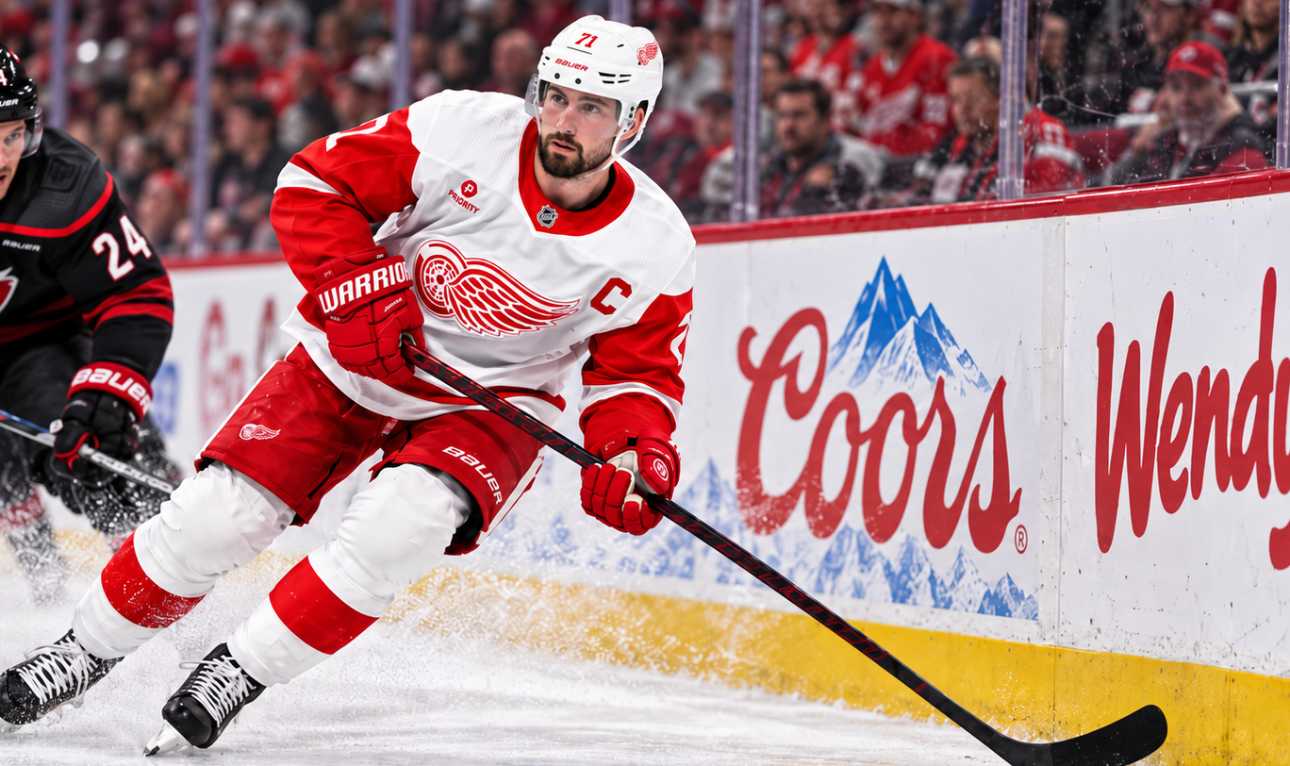
Dylan Larkin didn’t play in the Detroit Red Wings’ season opener Friday night, but he still became one of the biggest stories inside Little Caesars Arena.
When Larkin appeared during pregame introductions, the former Red Wings captain was greeted by loud boos from the Detroit crowd. It was the first unmistakable look at how some fans feel about a player who requested a trade following another season without playoff hockey. The Red Wings then lost 2-0 to the New York Rangers, with frustration inside the arena also spilling over into chants directed at ownership.
That immediately raises a much bigger question surrounding Dylan Larkin trade rumors: did opening night change the Detroit Red Wings’ timeline for resolving this situation?
My read is that the boos changed the pressure surrounding Larkin far more than they changed Detroit’s actual trade leverage. An uncomfortable relationship can become even more difficult once it plays out in front of a home crowd. But making a rushed trade because of one emotional night would be exactly the kind of decision the Red Wings need to avoid.
What happened Friday may not make a Dylan Larkin trade imminent. It does, however, make the status quo increasingly difficult to ignore.


Why Dylan Larkin’s Home-Opener Reception Matters to the Detroit Red Wings
There is no longer any question about whether Larkin really wanted out of Detroit.
Then-general manager Steve Yzerman publicly confirmed on June 27 that Larkin’s agent had informed the organization shortly after the 2025-26 season that the center wanted to be traded. Yzerman also revealed that Larkin’s camp subsequently supplied a short list of teams to which he would consider waiving his no-trade clause.
That earlier report was later confirmed by Larkin himself.
Speaking during training camp in September, Larkin acknowledged requesting a trade and said he understood there would be consequences. Detroit had already decided to begin the season without him as captain.
So this is no longer speculative NHL trade chatter built around an unhappy player.
There is a confirmed trade request.
There is a contractual mechanism limiting Detroit’s potential trade partners.
And now there is visible frustration coming from a portion of the Detroit Red Wings fan base.
The important distinction is that none of those things means Detroit must trade Larkin immediately.
Interim general manager Shawn Horcoff said Friday that Detroit’s priority is getting Larkin healthy and back on the ice. Larkin is dealing with an upper-body injury and was placed on injured reserve around the opener, though he has been skating with the team.
That matters considerably.
A healthy Dylan Larkin playing productive hockey is a significantly easier asset to trade than an injured Larkin surrounded by questions about his availability.
Dylan Larkin 3-Year Scoring Trend
Larkin’s production is another reason Detroit should resist allowing emotion to dictate the timing of a deal.
Over his past three seasons, he has produced 206 points in 224 games. In 2025-26 alone, Larkin had 34 goals and 67 points in 74 games while averaging 20:11 of ice time and winning 52.9 percent of his faceoffs.
Those aren’t the numbers of a player Detroit needs to dump.
They’re the numbers of a legitimate top-six center who can score 30-plus goals, play special teams and take difficult minutes.
Why Detroit Still Controls the Dylan Larkin Trade Clock
This is where Friday night’s boos become interesting.
From an emotional perspective, there may now be a greater incentive for both sides to find a resolution. Nobody benefits if every Larkin appearance at Little Caesars Arena becomes a referendum on his trade request.
But Detroit still has something critically important: contractual control.
Larkin carries an $8.7 million cap hit through the 2030-31 season. His contract contains a full no-trade clause this season before eventually converting to a modified no-trade clause later in the deal.
The rising NHL salary cap also makes that $8.7 million number less imposing than it once looked. Against the $104 million cap for 2026-27, Larkin occupies approximately 8.37 percent of the ceiling.
For a club that believes Larkin can remain a 65-to-75-point center, that isn’t an unreasonable percentage.
The bigger obstacle is his limited trade market.
If Larkin is only willing to waive his no-trade clause for a short group of teams, potential buyers know Detroit cannot simply auction him to all 31 other clubs. That’s where the Red Wings must be disciplined.
Detroit Red Wings–Larkin Salary Cap Calculator
We currently project Detroit with roughly $16.77 million in 2026-27 cap space, so the Red Wings aren’t under financial pressure to move Larkin simply to become cap compliant.
That changes the negotiating dynamic.
Detroit can afford to wait for Larkin to get healthy. It can afford to see whether his relationship with teammates and fans settles once he starts playing. And it can afford to tell interested teams that an unsatisfactory trade package isn’t enough.
NHLTradeRumor.com Trade Value Index
That is also why I don’t believe Friday night’s reaction should cause Detroit to dramatically lower its asking price.
If anything, the Red Wings’ biggest challenge is separating the public urgency from the hockey urgency.
The public urgency increased Friday.
The hockey urgency did not.
Detroit doesn’t suddenly need cap relief. Larkin’s contract isn’t expiring. His scoring hasn’t disappeared. And the team still needs legitimate NHL centers.
What has changed is the possibility that every home game could keep the story alive.
Head coach Todd McLellan acknowledged the awkwardness after the opener, saying, “It’s not comfortable for anybody.” Larkin had reportedly wanted to join the other scratches on the bench for introductions despite knowing what the reaction might be.
That’s an important detail because it doesn’t suggest Larkin is hiding from the situation.
The real test comes when he is healthy enough to play.
If Larkin returns, produces and helps the Detroit Red Wings win games, the temperature inside the arena could change quickly. Winning has a way of altering fan sentiment.
If the hostility continues regardless of his performance, the organization may eventually determine that carrying the situation deep into the season is becoming a distraction.
But there is a third possibility that shouldn’t be ignored: Detroit could simply wait until a team on Larkin’s approved list becomes motivated enough to meet its price.
That could take weeks or months.
Owner Chris Ilitch had already indicated in September that Larkin could remain with Detroit for the entire season despite the trade request. Friday’s reaction doesn’t erase that option.
The Dylan Larkin trade rumors therefore enter a different phase after opening night.
The question is no longer whether the trade request is real. It is.
The question is whether an increasingly uncomfortable environment eventually becomes strong enough to change the Detroit Red Wings’ patience.
Right now, I wouldn’t call a trade imminent.
But after what happened Friday night, every Larkin appearance, and every comment from Horcoff about his future — is going to carry considerably more weight.
Follow the Latest Detroit Red Wings News and Trade Rumors
Stay up to date on the latest Detroit Red Wings news, NHL trade rumors, contract updates and roster moves as the season unfolds. NHLTradeRumor.com tracks the speculation, trade chatter and developing stories that could impact the Red Wings lineup. While you’re here, join our NHL Fantasy Hockey Pool to test your GM skills against other hockey fans and compete for ultimate bragging rights. Looking for what channel the Red Wings game is on TV today? Visit our Detroit Red Wings TV schedule for game times, broadcast information and where to watch. Bookmark NHLTradeRumor.com and sign up for our newsletter above to get the biggest NHL trade rumors and news delivered directly to you.
Enjoying our trade coverage? Add us as a preferred source on Google to catch breaking rumors first.