

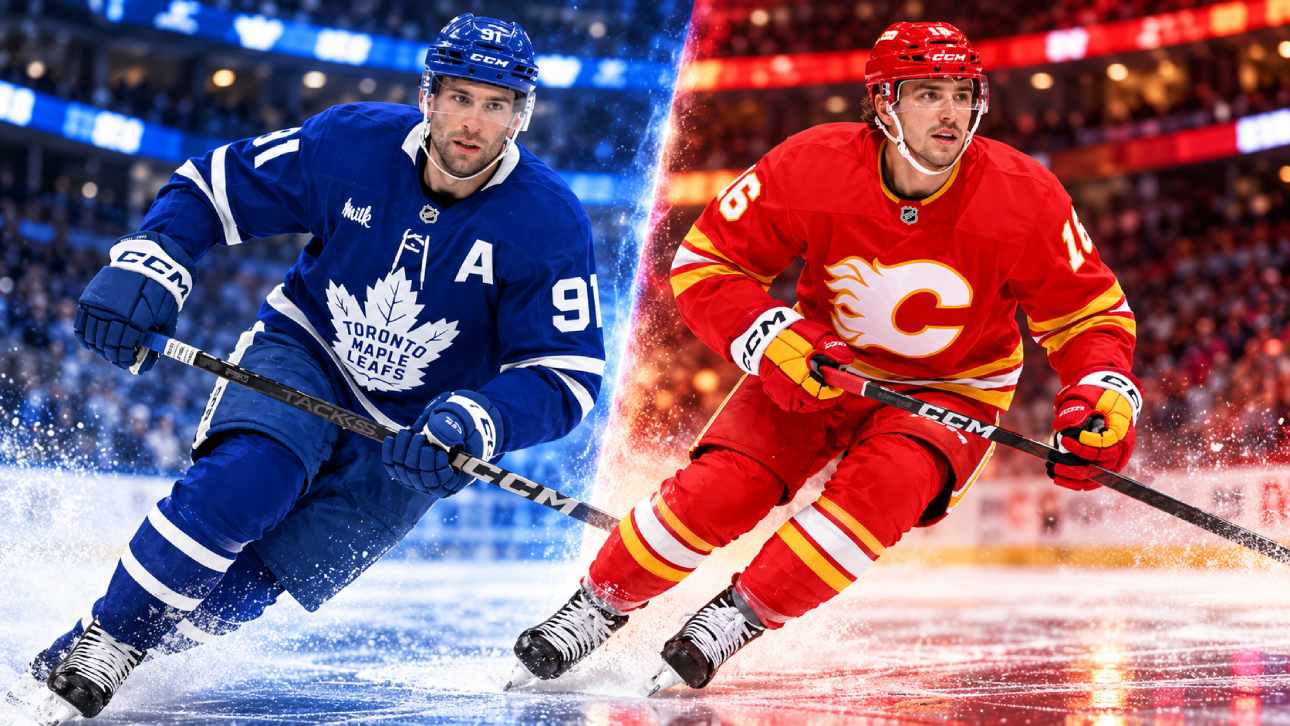
The Toronto Maple Leafs suddenly have a major problem down the middle, and the answer might be sitting on the Calgary Flames roster.
With John Tavares officially listed as week-to-week following a lower-body injury, Toronto is facing an uncomfortable question just eight games into the 2026-27 NHL season: Can the Maple Leafs survive without one of their most reliable offensive centres, or will management need to explore the NHL trade market sooner than expected?
One name worth watching is Morgan Frost.
The 27-year-old Calgary Flames centre has already generated trade interest around the NHL, according to earlier reporting from David Pagnotta. Frost is coming off a 22-goal season, carries a $4.375 million salary-cap hit and could become an unrestricted free agent next summer.
There is no confirmed report that Toronto and Calgary are negotiating a Frost trade. However, the combination of Tavares’ injury, Calgary’s difficult start and Frost’s uncertain long-term future makes this an intriguing potential fit.
And after examining the Maple Leafs’ lineup, I believe Toronto has a decision to make before this becomes a bigger problem.
John Tavares’ Injury Creates an Unexpected Maple Leafs Trade Problem
The Maple Leafs announced today, that Tavares is week-to-week with a lower-body injury suffered during Thursday’s 5-4 overtime loss to the Buffalo Sabres.
Tavares was injured following a collision with Buffalo forward Josh Norris and couldn’t finish the game.
The timing is particularly frustrating for Toronto.
Through seven appearances, Tavares had already collected two goals and five assists for seven points. He wasn’t simply providing veteran leadership or secondary scoring. He was producing at a point-per-game pace while giving the Leafs another dangerous option behind Auston Matthews.
Losing that production creates a chain reaction throughout the forward group.
Nick Paul moved into the second-line centre position for Saturday’s matchup against the New York Islanders, skating between Easton Cowan and Kirill Marchenko in the projected lineup. Colton Sissons and Teddy Blueger were positioned further down the middle.
That’s a workable temporary arrangement, but it comes with sacrifices.
Paul brings size, defensive responsibility and versatility. Sissons can handle difficult assignments, and Blueger provides reliable depth. However, asking those players to replace Tavares’ offensive contributions is another matter.
My concern isn’t whether Toronto has enough NHL centres. It’s whether the Leafs have enough centres who can create offence against difficult matchups.
That distinction could determine whether management eventually explores a trade.
Why Calgary Flames Centre Morgan Frost Is Worth Watching
Morgan Frost is an intriguing trade candidate because he occupies the space between an established offensive contributor and a player still trying to reach another level.
The former Philadelphia Flyers first-round selection scored a career-high 22 goals and recorded 43 points for Calgary during the 2025-26 campaign.
Those numbers matter.
Toronto doesn’t necessarily need another superstar. It needs someone who can handle meaningful minutes, create scoring chances and provide flexibility when injuries disrupt the lineup.
Frost has demonstrated enough offensive skill to deserve consideration for that responsibility.
The bigger development came October 7, when David Pagnotta reported on Daily Faceoff LIVE that Frost, Connor Zary and Zach Whitecloud were generating interest from other NHL teams.
That doesn’t guarantee Calgary will trade Frost. It does indicate that other organizations have been evaluating him.
Frost also has a contract situation that makes his future interesting. He is signed through the 2026-27 season and is scheduled to become an unrestricted free agent in 2027.
Calgary must eventually decide whether Frost belongs in its longer-term plans or whether his trade value could help reshape the franchise.
For the Maple Leafs, that creates a potential opportunity.
Would Morgan Frost Actually Fit Toronto’s Lineup?
Here’s where I find the possibility particularly interesting.
Frost is a left-shot centre with offensive creativity, good puck skills and the ability to contribute on the power play.
He’s not a direct replacement for everything Tavares provides. Toronto would still be losing an accomplished scorer with extensive experience controlling possession and generating offence around the net.
Frost’s value would come from a different approach.
He can help a line attack with speed, passing and controlled puck movement. In the right environment, those characteristics could complement a winger like Kirill Marchenko, who has already demonstrated his finishing ability this season.
Imagine Toronto experimenting with Frost between Cowan and Marchenko.
Cowan provides youthful energy. Marchenko brings a dangerous shot. Frost could become the distributor connecting those two offensive threats.
That’s the kind of combination that makes me interested in this potential trade.
However, it would be a mistake to describe Frost as a guaranteed second-line solution.
His defensive consistency and ability to handle tougher opposition remain important questions. Playing behind Matthews in Toronto would carry different expectations from playing significant minutes on a struggling Calgary team.
A trade would represent a calculated gamble, not an automatic upgrade.
Morgan Frost’s Offensive Upside Comes With a Warning
Frost’s offensive production deserves attention, but the underlying numbers provide a useful reality check.
Through his first seven games of 2026-27, Frost had two goals and one assist. His five-on-five expected-goals share was approximately 42%, according to PuckPedia.
That is not an encouraging territorial result, although seven games is far too small a sample to reach a firm conclusion.
It could reflect Calgary’s broader struggles, deployment, teammates or Frost’s own performance.
My view is that Toronto should evaluate Frost as an offensive improvement candidate rather than someone who immediately fixes every aspect of its centre depth.
His ability to generate offence is attractive. His defensive results need closer examination.


Could the Toronto Maple Leafs Afford Morgan Frost?
The salary cap is where this hypothetical deal becomes especially interesting.
Frost carries a $4.375 million annual cap hit on the final season of his two-year, $8.75 million contract.
The NHL’s salary-cap ceiling for 2026-27 is $104 million. Toronto has approximately $4.925 million in current cap space, with the figure influenced by its injury and long-term injured reserve situation.
On a simple cap-hit comparison, Frost’s full salary would leave roughly $550,000 of that reported space.
But that doesn’t mean Toronto can automatically complete the trade without complications.
Roster movements, injury designations, the club’s existing LTIR commitments, and Tavares’ eventual return would all affect the calculation.
There is also a second possibility: Calgary retaining salary.
At 50% retention, Frost would carry a $2.1875 million cap charge for Toronto. That would make the financial picture considerably more manageable, but Calgary would need additional incentive to retain salary.
One important detail is that Frost has an eight-team no-trade list this season. A potential destination would need to satisfy that contractual restriction.
My assessment: Frost’s contract is manageable enough to investigate, but Toronto should not mistake short-term injury-related flexibility for permanently available cap room.
A deal must still make sense when the roster gets healthier.
Could Toronto Afford Morgan Frost?
Maple Leafs × Flames | October 17, 2026
Sources: PuckPedia, October 17 snapshot. Numbers rounded for display. Not a live cap feed or confirmed trade proposal.
What Would the Calgary Flames Want in a Morgan Frost Trade?
This is where an intriguing idea becomes a difficult negotiation.
Calgary isn’t obligated to move Frost simply because another team has an injury.
The Flames have endured a difficult opening to their season, including a 6-2 loss to Vegas on October 15 that dropped their record to 1-6-0.
A poor start naturally increases speculation about potential roster changes. Still, Calgary needs to consider whether trading an established 27-year-old centre actually improves its long-term outlook.
From Toronto’s perspective, I would avoid surrendering a first-round pick for Frost.
He’s a useful NHL player with offensive upside, but the fact that he could become an unrestricted free agent next summer introduces risk.
An illustrative opening offer could involve Toronto’s 2028 second-round pick and a developmental prospect, with the final price influenced by whether Calgary retains salary.
That isn’t a reported offer or an agreed valuation. It’s my assessment of a reasonable starting framework.
If Calgary demands a premium first-round pick plus an NHL-ready prospect, I would walk away.
Toronto cannot afford to sacrifice valuable future assets every time an injury exposes a weakness.
Morgan Frost: Trade Fit Index
NHLTradeRumor.com editorial model. Five equally weighted subjective factors, rated 1–5. Total 16/25 = 64/100. Not an insider report, statistical prediction, accepted offer or verified asking price.
What the Numbers Tell Us About Frost and Tavares
The most useful comparison isn’t simply career points. It’s what each player has contributed offensively in the current season.
Through seven games, Tavares had seven points, compared with three for Frost.
That translates to 1.00 points per game for Tavares and approximately 0.43 for Frost.
Those numbers underline why Frost shouldn’t be presented as a one-for-one replacement.
Tavares was producing at a significantly higher rate before his injury.
However, the comparison also highlights something else: Frost’s full-season scoring ceiling is more meaningful than his first seven games.
His 22 goals last year show that he can contribute to an NHL offence over a much larger sample.
Toronto’s decision-makers would need to separate early-season results from established production while considering the differences between the two teams.
A well-run scouting department should also examine Frost’s controlled entries, passing efficiency, defensive-zone exits and performance against stronger competition.
Those details would offer a better picture of whether he could succeed in Toronto’s middle six than a short scoring streak.
Tavares vs. Frost: Offensive Output
2026-27 regular season | Through October 17
Stats: PuckPedia, October 17 snapshot. Small samples and differing team situations limit comparison. This chart does not predict future performance.
Why Calgary Might Be Willing to Listen
The Calgary Flames have bigger decisions ahead than whether Morgan Frost can help them win their next game.
If the organization views its current roster as part of a longer retool, converting an expiring contract into future assets could become attractive.
Frost is old enough to be an established NHL player but still young enough to appeal to teams seeking more than a short-term rental.
That gives Calgary options.
The Flames could keep him, explore a contract extension or wait until demand for centres increases closer to the trade deadline.
They could also entertain an earlier offer if a team provides sufficient value.
I wouldn’t expect Calgary to give Frost away simply because the Maple Leafs have an immediate need.
In fact, Toronto’s injury situation could weaken its negotiating position if Calgary believes the Leafs are desperate.
That is precisely why patience matters.
Should Toronto Trade Now or Wait for Tavares?
There are three realistic paths.
The first is to trust the current roster and allow Paul, Sissons and Blueger to absorb additional responsibilities while Tavares recovers.
The second is to explore a lower-cost depth addition that doesn’t require substantial draft capital.
The third is to pursue a more meaningful addition like Frost, who could provide value even after Tavares returns.
I prefer the third option only if Toronto sees Frost as part of its plans beyond the immediate injury.
If the Leafs acquire him simply to cover several weeks, the asset cost could prove excessive.
But if management believes Frost can strengthen the middle six through the spring, it’s a different conversation.
There is also the possibility of returning Tavares to a more flexible role once healthy, giving the coaching staff multiple options at centre and on the wing.
Depth matters over an 82-game season. Having another offensive centre available isn’t necessarily a luxury.
My Verdict: Morgan Frost Makes Sense, but Toronto Cannot Panic
I believe Morgan Frost is a legitimate player for the Toronto Maple Leafs to evaluate.
He’s 27, has demonstrated 20-goal ability and plays a position where Toronto has suddenly lost one of its most important offensive contributors.
His contract isn’t outrageous, and his impending unrestricted free agency could create a trade opportunity if Calgary decides to prioritize future assets.
However, there is a difference between identifying a sensible trade target and paying whatever it takes to acquire him.
Toronto should first determine whether its existing centres can maintain the team’s offensive structure. If that fails, the Maple Leafs have stronger justification to investigate Frost and other available options.
My biggest takeaway is simple.
The Leafs shouldn’t trade for Morgan Frost because John Tavares got hurt. They should trade for Frost only if they believe he makes the team better after Tavares returns.
That’s the difference between an emotional reaction to an injury and a smart NHL roster decision.
And with both Toronto and Calgary facing important questions early in the season, this is one potential trade fit worth monitoring.
Follow the Latest Toronto Maple Leafs News and Trade Rumors
Stay up to date on the latest Toronto Maple Leafs news, NHL trade rumors, contract updates and roster moves as the season unfolds. NHLTradeRumor.com tracks the speculation, trade chatter and developing stories that could impact the Leafs lineup. While you’re here, join our NHL Fantasy Hockey Pool to test your GM skills against other hockey fans and compete for ultimate bragging rights. Looking for what channel the Leafs game is on TV today? Visit our Toronto Maple Leafs TV schedule for game times, broadcast information and where to watch. Bookmark NHLTradeRumor.com and sign up for our newsletter below to get the biggest NHL trade rumors and news delivered directly to you.
Enjoying our trade coverage? Add us as a preferred source on Google to catch breaking rumors first.