

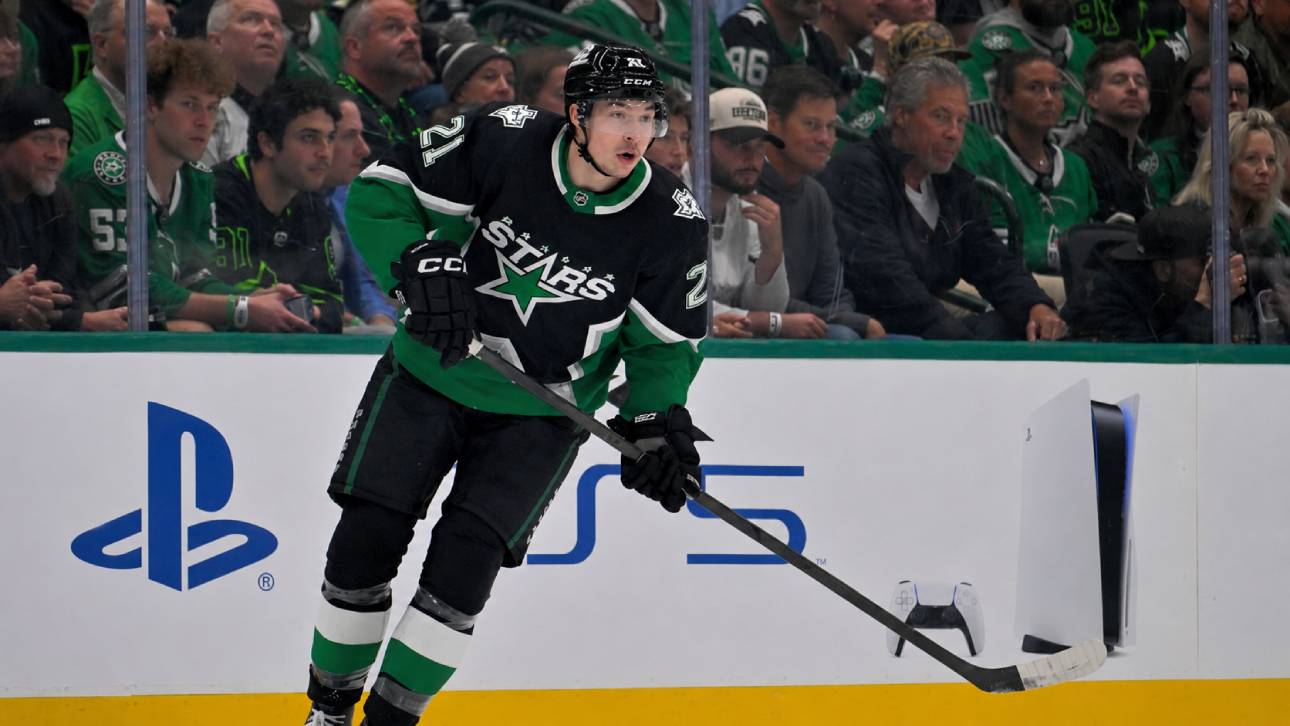
The Dallas Stars are no longer dealing with an ordinary restricted free-agent negotiation. With Jason Robertson’s salary-arbitration hearing scheduled for July 25, Dallas is approaching a deadline that could dramatically change the future of the franchise.
Robertson filed for arbitration after producing 45 goals and 96 points in 82 games during the 2025-26 season. Because he is only one year away from unrestricted free agency, an arbitration award can only cover one season. That means Dallas could retain Robertson for 2026-27, only to watch one of the NHL’s most productive wingers reach the open market next summer.
That is the danger facing general manager Jim Nill. The Stars can sign Robertson to a long-term contract, trade him while his value remains exceptionally high, or accept a one-year arbitration result that weakens their negotiating position.
In my view, allowing this situation to reach arbitration would be the riskiest option. Once Robertson is carrying a one-year contract directly into unrestricted free agency, every interested team knows Dallas is operating against the clock.
Why the Dallas Stars Could Trade Jason Robertson Before Arbitration
The Stars have repeatedly stated that their objective is to keep Robertson. Nill recently characterized the situation as part of the negotiating process, adding that the team’s goal is to get him signed. That remains the most logical outcome for a Stanley Cup contender.
However, the finances are becoming increasingly difficult.
PuckPedia currently projects the Dallas Stars at approximately $10.64 million in cap space, with 21 of 23 active roster positions filled. Robertson’s previous contract carried a $7.75 million cap hit, but his 45-goal season has pushed his market value well beyond that figure.
Sportsnet reported that the Stars and Robertson were believed to be at least $2 million apart annually during negotiations. Dallas was reportedly hoping to keep his cap hit somewhere around Mikko Rantanen’s $12 million salary.
A hypothetical $12.5 million Robertson contract would leave Dallas approximately $1.86 million over the cap before completing its roster. That is not an impossible problem, but it would require another transaction.
The real issue is not simply whether Dallas can create enough space. It is whether Robertson is prepared to sign the type of long-term contract the Stars are comfortable carrying.
The Rejected Seattle Offer Changed the Entire Market
The clearest indication of the divide came before the NHL Draft.
Sportsnet’s Elliotte Friedman reported that Dallas gave the Seattle Kraken permission to negotiate directly with Robertson. Seattle reportedly offered him approximately $15 million per season over eight years, but Robertson declined.
The Stars and Kraken were also believed to have established the framework of a trade that included Seattle’s seventh-overall selection in the 2026 NHL Draft. Neither club nor Robertson’s representative commented publicly on the negotiations.
That development was important for two reasons.
First, it showed that Dallas was genuinely willing to explore a Robertson trade. This was not simply an opposing general manager calling to ask whether a star player might be available.
Second, Robertson’s rejection demonstrated that acquiring him requires more than satisfying the Stars’ trade demands. Any team paying a premium package will want confidence that Robertson is willing to sign a long-term extension.
That gives the player significant control over his next destination, even without a formal no-trade clause.
Jason Robertson Career NHL Stats

Jason Robertson
Type GP G A P +/- Regular Season 465 216 283 499 +121 Playoffs 62 23 29 52 -6

Jason Robertson’s Production Gives Dallas a Difficult Choice
Robertson led the Dallas Stars with 45 goals, 51 assists, and 96 points last season. He also scored five goals in six playoff games and finished among the NHL’s top players in goals, power-play production and high-danger scoring.
Those numbers explain why trading him would be so difficult.
Robertson is not an aging veteran whose best seasons are behind him. He turns 27 on July 22 and has already recorded a 109-point season. He is a legitimate first-line winger, an elite power-play weapon and one of the league’s most reliable finishers.
My concern for Dallas is that replacing Robertson would likely require multiple players. The Stars might receive premium draft picks, a young NHL forward, and a top prospect, but none would be guaranteed to replace 45 goals immediately.
Dallas is trying to win the Stanley Cup now. Moving Robertson for futures could make the organization financially healthier while making the current roster weaker.
Which Teams Could Afford Jason Robertson?
The following calculation uses a hypothetical $12.5 million cap hit and publicly listed PuckPedia projections as of July 19, 2026. It does not account for contracts included in a trade, buried salaries, injuries, or subsequent roster moves.
| Team | Projected cap space | Space after $12.5M contract | Assessment |
|---|---|---|---|
| Chicago Blackhawks | $29.31M | $16.81M | Easiest financial fit |
| Seattle Kraken | $18.41M | $5.91M | Can add him without major shedding |
| Philadelphia Flyers | $13.94M | $1.44M | Possible, but leaves little flexibility |
| Pittsburgh Penguins | $13.68M | $1.18M | Possible with careful roster management |
| San Jose Sharks | $12.94M | $0.44M | Technically possible, but another move likely |
| Dallas Stars | $10.64M | -$1.86M | Must clear additional salary |
The cap figures show why Seattle continues to make sense financially. Chicago would have the cleanest path to absorbing a Robertson contract, while Philadelphia, Pittsburgh, and San Jose could make it work with additional roster management.
Chicago, Philadelphia, and San Jose should be viewed as editorial cap-fit candidates rather than confirmed bidders. The Fourth Period has specifically identified Ottawa, Detroit, Seattle, Utah, and Pittsburgh among the clubs believed to have expressed interest.
Ottawa and Utah currently lack the immediate space to add a $12.5 million contract without sending meaningful salary back to Dallas. That does not eliminate either team, but it makes the construction of a trade considerably more complicated.
Our Jason Robertson Trade-Value Model
Using an editorial trade-value model that weighs NHL production, age, durability, postseason value, positional importance, and contractual leverage, Robertson receives an estimated score of 83 out of 100.
| Category | Score |
|---|---|
| NHL production | 29/30 |
| Age and durability | 18/20 |
| Playoff and lineup impact | 13/15 |
| Contract control | 9/20 |
| League-wide demand | 14/15 |
| Total trade-value score | 83/100 |
Robertson loses points almost entirely because of his contract situation. His on-ice value is elite, but an acquiring team cannot treat him like a player already secured for seven or eight seasons.
A reasonable trade framework would likely require a premium young NHL player, a first-round pick, and at least one additional high-value prospect or selection. Dallas should not move Robertson for a collection of uncertain futures unless the organization believes a long-term agreement is no longer realistic.
This model is an original editorial framework, not inside information or a report of Dallas’ actual asking price.
Why Keeping Robertson Still Makes the Most Sense
Despite the growing trade rumors, my preferred outcome for the Dallas Stars remains a long-term extension.
Elite scorers entering their prime rarely become available, and Dallas already knows Robertson succeeds beside its core players. The Stars would be taking a significant risk by trading a 45-goal winger and hoping that several incoming pieces eventually provide equal value.
The best solution may be a Robertson contract near the top of Dallas’ salary structure, followed by a separate move to create cap space. It is easier to replace a middle-pairing defenceman or complementary forward than it is to replace one of the league’s best goal scorers.
However, if Robertson is unwilling to sign for the term or salary Dallas can accommodate, the Stars must act decisively. Trading him before arbitration would allow an acquiring team to negotiate a new contract while giving Dallas the strongest possible leverage.
The earlier Seattle report has now been partially reinforced by subsequent events. No trade was completed, but Robertson’s arbitration filing confirms that the two sides still have not reached the long-term resolution Dallas needs. The closer this situation gets to July 25, the more dangerous it becomes.
Find the Latest Dallas Stars News
For the latest Dallas Stars news, Jason Robertson trade rumors, roster updates, and NHL salary-cap analysis, add nhltraderumor.com to your bookmarks. While you’re here, don’t forget to join our official NHL Hockey Pool this season to test your general manager skills and compete for the ultimate bragging rights. You can also find information on how to watch the Stars game on TV today on our website.
Enjoying our trade coverage? Add us as a preferred source on Google to catch breaking rumors first.