

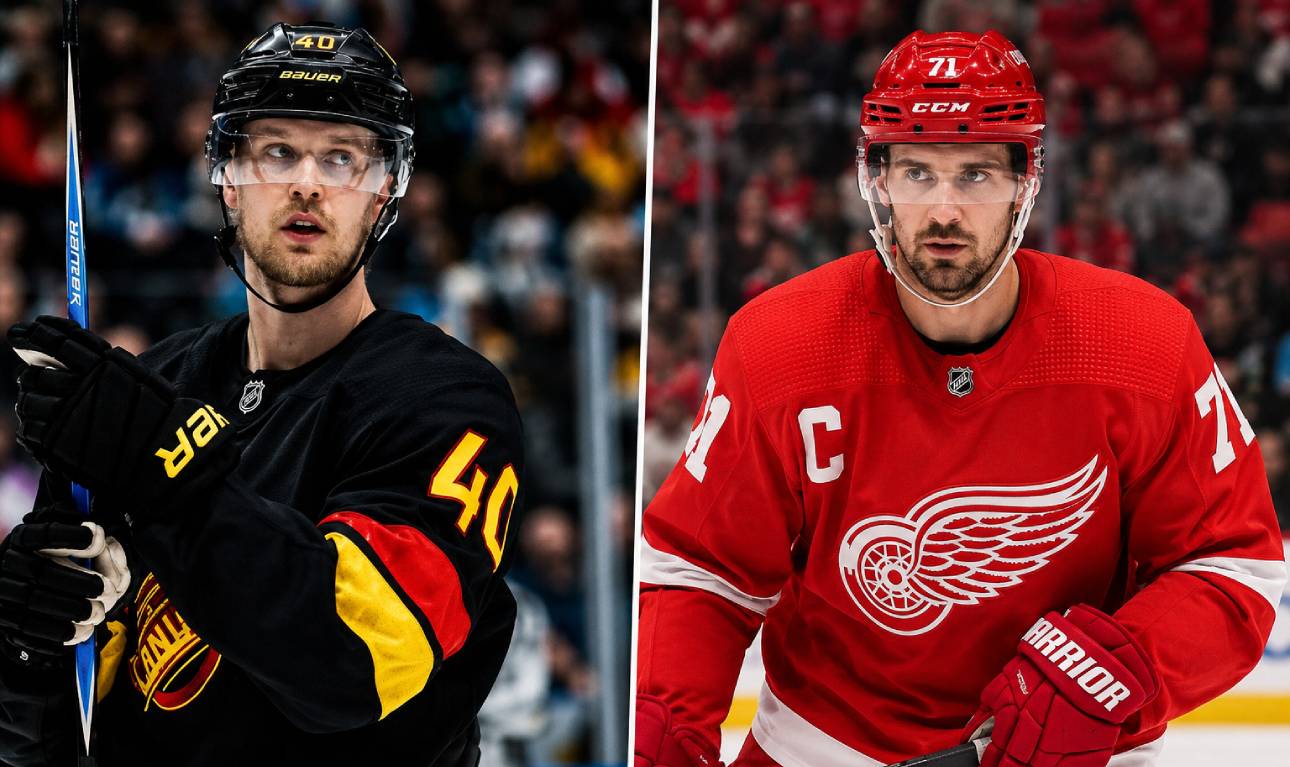
The Minnesota Wild’s pursuit of Dylan Larkin is not necessarily dead, but completing the deal has become far more complicated. Minnesota general manager Bill Guerin still has an obvious need for a legitimate first-line center, while the Detroit Red Wings must decide whether their captain remains part of the franchise’s next chapter. The biggest change is no longer on the ice: Steve Yzerman has transitioned out of Detroit’s general manager position, and the organization is searching for a new head of hockey operations.
Here is the immediate takeaway: a direct Minnesota-Detroit trade appears difficult because the Wild will not move Matt Boldy, but a three-team structure involving the Vancouver Canucks and Elias Pettersson could create another path. Our proposed framework makes sense conceptually because each team addresses a different need. Minnesota gets its center, Detroit replaces Larkin with another talented center, and Vancouver adds futures while reducing its payroll. However, the current version still asks Vancouver to retain too much money for too little certainty.
Why the Minnesota Wild May Need the Vancouver Canucks to Land Dylan Larkin
Jess Myers’ latest reporting indicated that things have been relatively quiet around the Wild since their additions of Blake Coleman and Olli Maatta. Minnesota’s interest in Larkin remains an important part of the offseason picture, but Detroit’s front-office transition may pause meaningful negotiations until a permanent decision-maker is hired.
That delay could work in either direction.
A new Detroit Red Wings general manager may view Larkin as the player around whom the team should continue building. Removing Yzerman from the general manager’s chair could also help repair the relationship between the organization and its captain. Conversely, a new executive could conclude that trading Larkin is the cleanest way to reshape the roster and establish a new direction.
Larkin reportedly identified the Minnesota Wild, Florida Panthers and Vegas Golden Knights as teams he would consider joining. His full no-trade protection gives him significant control over the process, which strengthens Minnesota’s position if the Wild remain one of his preferred destinations.
Why Matt Boldy Should Remain Off Limits
The rumored Detroit asking price involving Matt Boldy should be a non-starter for Guerin.
Larkin would immediately improve Minnesota down the middle, but exchanging Boldy for him would solve one major roster problem by creating another. Boldy is younger, signed for $7 million annually through 2029-30 and already established as one of the Wild’s most important offensive players. Reports connecting Boldy to Detroit demonstrate how highly the Red Wings value Larkin, but they do not make the proposed exchange sensible for Minnesota.
Larkin remains an excellent player. He produced 34 goals and 67 points in 74 games during the 2025-26 season and carries an $8.7 million cap hit through 2030-31. That combination of speed, leadership, two-way responsibility and goal production is exactly what Minnesota needs.
Dylan Larkin Career NHL Stats

Dylan Larkin
Type GP G A P +/- Regular Season 808 276 367 643 -100 Playoffs 5 1 0 1 -2

How the Three-Team Dylan Larkin Trade Would Work
Minnesota Wild receive: Dylan Larkin
Vancouver Canucks receive: Ryan Hartman, Danila Yurov, Minnesota’s 2028 first-round pick
Detroit Red Wings receive: Elias Pettersson with $2.6 million retained by Vancouver
The hockey logic is easy to understand.
Minnesota acquires the first-line center it has been pursuing without sacrificing Boldy. Detroit replaces Larkin with Pettersson, a highly skilled center who could benefit from a change of environment. Vancouver turns a massive long-term contract into a veteran forward, a talented young player and a future first-round selection.
The difficult part is determining whether the value and salary obligations are balanced.
Pettersson is signed through 2031-32 with an $11.6 million cap hit and holds a full no-movement clause. He recorded 15 goals and 51 points in 74 games last season, well below the level expected from Vancouver’s highest-paid player.
Retaining $2.6 million would lower Pettersson’s cap charge for Detroit to exactly $9 million. That makes him only $300,000 more expensive than Larkin, giving the Red Wings a manageable financial exchange while betting on Pettersson rediscovering his previous elite form.
Proprietary Salary-Cap Calculation
The NHLTradeRumor.com trade-fit score weighs current player impact at 40 percent, age and contractual control at 25 percent, salary-cap efficiency at 20 percent and organizational fit at 15 percent. It is an editorial evaluation model, not an official NHL valuation system.
Hartman carries a $4 million cap hit for one more season, while Yurov’s cap charge is approximately $973,000. Minnesota would therefore move out roughly $4.97 million while adding Larkin at $8.7 million, increasing its projected payroll by approximately $3.73 million.
Minnesota currently has only about $1.12 million in projected cap space against the NHL’s $104 million ceiling. Before accounting for another roster demotion or transaction, Guerin would need to clear approximately $2.61 million more to complete this version of the trade.
For Vancouver, the first-year calculation produces approximately $4.03 million in cap relief. The concern is that the Canucks would carry a $2.6 million retained cap charge through 2031-32. That represents $15.6 million in retained cap allocation over six seasons, which is an enormous commitment for a rebuilding team.
My Verdict: Vancouver Needs More to Approve This Deal
From Minnesota’s perspective, this is the type of aggressive move Guerin should investigate. The Wild would preserve Boldy, add an established first-line center and reinforce a legitimate win-now core.
Detroit’s decision is more complicated. Pettersson at $9 million could become an excellent investment if he rebounds, but the Red Wings would be exchanging a proven 34-goal captain for a player coming off a 15-goal season. Detroit’s new general manager would need to believe Pettersson’s ceiling outweighs the security provided by Larkin.
Vancouver is the team most likely to reject the proposed structure. Yurov is a legitimate young asset and the 2028 first-round pick carries value, but Hartman is one year from unrestricted free agency, and the draft pick is several years away. That return probably does not justify retaining $2.6 million for the remainder of Pettersson’s contract.
My adjustment would be to reduce Vancouver’s retention to approximately $1.5 million and add a conditional future selection to the Canucks’ return. Detroit has enough projected cap flexibility to absorb a larger portion of Pettersson’s contract, while Vancouver would receive greater compensation for surrendering a potentially elite center. Detroit currently projects to have considerably more cap room than Minnesota, making that alteration financially realistic.
The most likely outcome remains patience. Guerin can wait for Detroit to appoint its next general manager and determine whether Larkin still wants a trade after speaking with the organization’s new decision-maker. But if Larkin remains committed to leaving and Boldy remains unavailable, adding Vancouver to the negotiations may be the most realistic way to reopen the conversation.
Find the Latest Minnesota Wild News and NHL Trade Rumors
For the latest Minnesota Wild news, Dylan Larkin trade rumors, Detroit Red Wings updates and Vancouver Canucks speculation involving Elias Pettersson, add nhltraderumor.com to your bookmarks. While you are here, join our official NHL Hockey Pool this season to test your general manager skills and compete for the ultimate bragging rights. You can also find out how to watch the MN Wild game on TV today with our updated team television schedules.
Enjoying our trade coverage? Add us as a preferred source on Google to catch breaking rumors first.





Rob must be getting awfully bored. None of this makes sense. Why does Petttersson waive to go to Detroit of all places, AFTER Larkin leaves, when Pettersson could demand to go to a much better team somewhere warm? Answer: He doesnt.
I’m a diehard DRW fan. I don’t want Pettersson. I’d rather make the trade straight up with the Wild for Hartman, Yurov, and the 1st round pick. Pettersson has not lived up to his $12 million AAV contract. That’s why J.T. Miller was so pissed when he was at Vancouver.