

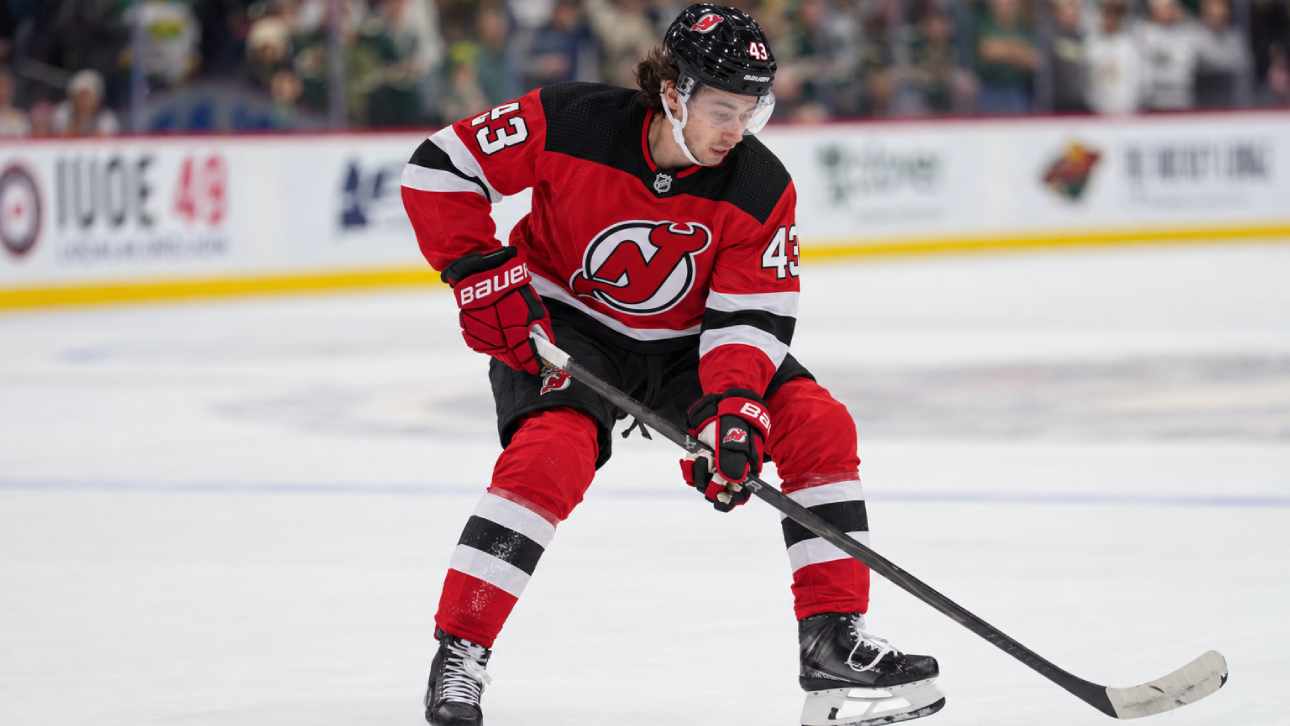
The New Jersey Devils have already pulled off one of the biggest NHL trades of the 2026–27 season. Now, an even more intriguing question is emerging: could Quinn Hughes eventually join his brothers in New Jersey?
Friday’s blockbuster acquisition of Connor Hellebuyck from the Winnipeg Jets has dramatically changed the conversation surrounding the Devils’ championship ambitions. But the bigger story might involve a superstar defenseman who currently plays for the Minnesota Wild.
Quinn Hughes remains unsigned beyond this season, and NHL insider Jeff Marek believes New Jersey could still be a factor in his future.
The Devils now have Hellebuyck, Jack Hughes, Luke Hughes and a general manager who has demonstrated a willingness to make a franchise-altering move.
Minnesota, meanwhile, has its own plans for Quinn Hughes, including speculation surrounding Detroit Red Wings captain Dylan Larkin.
There is no confirmed trade involving Hughes. But after Friday’s developments, the battle to determine where one of hockey’s best defensemen plays beyond 2026–27 deserves considerably more attention.
And the deciding factor might not be money.
Why the Connor Hellebuyck Trade Changes the Quinn Hughes Conversation
On October 23, the Devils officially acquired three-time Vezina Trophy winner Connor Hellebuyck from Winnipeg.
The price was substantial. New Jersey surrendered Dawson Mercer, Nico Daws, Nick Bjugstad, 2026 first-round prospect Alexander Command, a 2029 second-round pick and a 2027 seventh-round pick.
That is not the sort of package a rebuilding organization sacrifices for short-term improvement. It’s a calculated investment in winning immediately.
Hellebuyck, 33, carries an $8.5 million annual salary-cap hit through the 2030–31 season. He also joins a Devils organization that already possesses an intriguing core featuring Jack Hughes, Nico Hischier, Jesper Bratt and Luke Hughes.
The goaltending situation was becoming difficult to ignore. New Jersey’s early-season save percentage ranked among the league’s lower figures despite the team generating encouraging defensive metrics.
Hellebuyck changes the potential ceiling of this roster. But here’s where things become interesting.
If you’re Quinn Hughes, watching New Jersey acquire one of the NHL’s most accomplished goaltenders could influence how you evaluate your own future.
For years, the possibility of playing alongside brothers Jack and Luke has followed Quinn around the league. Now, New Jersey can offer more than an emotional reunion.
It can offer a legitimate championship argument.
That doesn’t mean Hughes wants to leave Minnesota. It means New Jersey has strengthened one of the most important elements of its potential recruiting pitch.
NHL Insider Jeff Marek Keeps the Devils in the Quinn Hughes Discussion
During Friday’s edition of Daily Faceoff LIVE, NHL insider Jeff Marek discussed whether Hellebuyck’s acquisition represented New Jersey’s final significant roster move.
His response kept the Quinn Hughes conversation alive. Marek said he believes the Devils could remain in the discussion for Hughes despite having already invested significant assets in Hellebuyck.
Importantly, Marek also connected Hughes’ future to the possibility of Minnesota acquiring Detroit Red Wings captain Dylan Larkin.
The theory is fascinating. If the Wild can acquire Larkin, an established top-six centre with connections to Hughes, Minnesota might be better positioned to convince its superstar defenseman that the organization is committed to building a long-term championship contender.
If that doesn’t happen, the uncertainty surrounding Hughes could continue.
Another complication raised by Marek involves Luke Hughes. Quinn’s arrival would create an exceptional defensive pairing opportunity, but it would also require the Devils to reconsider power-play responsibilities and deployment.
These are observations about roster construction and potential moves, not confirmation of active negotiations between New Jersey and Minnesota.
Still, they highlight how much more complicated this situation is than simply placing three brothers on one team.
Why the Minnesota Wild Cannot Afford to Lose Quinn Hughes
The Minnesota Wild didn’t acquire Hughes simply to enjoy one full season of elite production.
In December 2025, general manager Bill Guerin traded Marco Rossi, Liam Öhgren, Zeev Buium and a first-round draft pick to the Vancouver Canucks to acquire the dynamic defenseman.
That package tells you everything about Minnesota’s intentions.
The Wild sacrificed an established young forward, promising prospects and significant draft capital because they believed Hughes could transform their organization.
Now comes the difficult part: securing his future. Hughes’ six-year, $47.1 million contract expires following the 2026–27 season. His $7.85 million cap hit makes him one of hockey’s more valuable contracts relative to his overall impact.
Minnesota owner Craig Leipold expressed confidence during the offseason that the organization would reach an extension.
But Hughes has approached the situation differently. In September, he told NHL.com that he did not feel pressured to rush his decision.
That matters.
A player exercising patience is not automatically a player demanding a trade.
Hughes has spoken positively about Minnesota. The Wild have made keeping him a major organizational priority.
My concern for Minnesota is not whether it wants Hughes badly enough.
It’s whether the Wild can demonstrate that their championship window aligns with the prime years of his career.
For a player capable of changing an entire defensive structure, that competitive vision may matter as much as the contract offer.
Quinn Hughes: Elite Production
Quinn Hughes’ Early-Season Numbers Explain His Enormous Trade Value
Through 11 games in the 2026–27 season, Hughes has recorded two goals and 11 assists for 13 points.
That’s a 97-point pace across 82 games.
Even more impressive, he’s averaging approximately 27 minutes and 25 seconds of ice time per game.
Those numbers illustrate why Hughes is such a difficult player to replace.
He’s not simply a point-producing defenseman. He moves the puck through pressure, drives transition offense and gives his team another attacking option without sacrificing the ability to recover defensively.
Watch how frequently Hughes turns what appears to be a routine defensive-zone possession into an offensive opportunity.
He changes the geometry of the ice.
Defenders must respect his movement along the blue line, forwards receive cleaner entries, and opponents have less time to organize their defensive coverage.
That’s why I believe the value of Hughes extends beyond the traditional points column.
His possession-driving ability improves the opportunities available to teammates.
The 97-point pace is based on a small early-season sample, but his influence is supported by years of elite performance, including his Norris Trophy-winning 2023–24 campaign.
For Minnesota, losing that player would create a hole that even multiple incoming assets might struggle to fill.
Could the New Jersey Devils Actually Afford Quinn Hughes?
Here is where the speculation encounters a serious obstacle.
The Devils already have significant long-term money committed to their core.
Jack Hughes carries an $8 million cap hit, Luke Hughes costs $9 million annually, and Hellebuyck adds another $8.5 million.
Quinn’s current contract adds $7.85 million.
Putting all four players together would represent $33.35 million in annual cap commitments at their existing rates, or approximately 32.1% of the NHL’s $104 million salary-cap ceiling.
And that’s before accounting for Hischier, Bratt, Timo Meier, other defensemen and the rest of the roster.
Quinn is also due for a new contract in 2027. His next cap hit could be substantially higher than $7.85 million.
The Devils would need to move salary, consider the timing of the acquisition and potentially make difficult decisions regarding established roster players.
The long-term salary-cap outlook is more encouraging because the league’s projected ceiling rises to $113.5 million for 2027–28.
However, extra leaguewide cap space does not automatically make a superstar acquisition affordable.
New Jersey would still need to balance an enormous investment in a small group of elite players against the necessity of maintaining forward depth, defensive stability and reliable secondary scoring.
The Hughes Cap Challenge
What could 2027-28 look like?
*Quinn is currently a Minnesota Wild player. Three proposed extension values are editorial scenarios, not negotiations or contract projections. Shares use a projected 2027-28 cap ceiling of $113.5M and include only Jack, Luke, Connor and Quinn. Full roster cap compliance is not modeled.
Sources: PuckPedia player contracts, NHL/NHLPA published payroll ranges. Calculations: NHLTradeRumor.com.
What Would a Quinn Hughes Trade Cost the Devils?
This is the question many trade-rumor discussions fail to examine closely enough.
Minnesota paid a considerable price for Hughes less than a year ago. Trading him now would be an extraordinary decision unless the Wild became convinced that an extension was unlikely.
And even then, Minnesota would not be obligated to sell cheaply.
Any potential return would need to address several objectives: replacing a portion of Hughes’ defensive impact, recovering premium young talent and preserving enough cap flexibility to remain competitive.
New Jersey also faces an asset-management challenge.
The Devils just surrendered Mercer, Daws, Command and two draft picks in the Hellebuyck deal.
Their remaining prospect and draft capital would have to support any further blockbuster negotiation.
My view is that acquiring Hughes would likely require a combination of valuable young NHL talent and significant futures, rather than an assortment of expendable depth players.
Could another team help facilitate the transaction through a more complicated deal? It’s possible.
But without reported negotiations, attaching specific names to a proposed trade package would be speculation rather than reporting.
The key question isn’t whether a theoretical trade package can be invented.
It’s whether New Jersey can offer enough that Bill Guerin would seriously consider moving his most important defenseman.
Quinn Hughes to New Jersey
Method: Four editorial ratings on a 1–5 scale, multiplied by stated weights. 5×30% + 2×25% + 1×25% + 2×20% = 2.65/5, or 53/100. This measures our assessment of practical fit and difficulty, not the probability of a completed trade. No team or agent supplied these ratings.
The Hughes Brothers Reunion Has One Complication Nobody Should Ignore
The potential reunion of Quinn, Jack and Luke Hughes would be one of hockey’s most compelling stories.
Imagine New Jersey building around three exceptionally talented brothers, supported by Hellebuyck in goal.
The marketing appeal would be enormous. But hockey operations must come first.
Quinn and Luke are both offensive-minded defensemen capable of running a top power-play unit.
Would they play together at even strength? Could one take on a different offensive responsibility? How would New Jersey distribute the most valuable offensive-zone minutes?
These are solvable problems, but they are real ones.
I would view Quinn as the primary puck-moving defenseman on an elite first unit, with Luke capable of driving another pairing and giving New Jersey exceptional offensive depth.
That arrangement could make the Devils far more difficult to defend over 60 minutes.
Still, the potential financial cost cannot be ignored.
Building a team around star power is only effective when the supporting roster remains competitive.
My Take: The Devils Are More Attractive, but Minnesota Still Controls the Situation
I believe Friday’s Hellebuyck trade makes New Jersey a more credible long-term destination for Quinn Hughes.
That’s different from believing a trade is imminent.
The Devils have improved their championship outlook with an elite goaltender and made a substantial organizational commitment to winning.
Minnesota, however, possesses Hughes’ current contract, has already invested heavily in acquiring him and has every reason to fight for his signature.
What happens next may depend more on the Wild’s performance and roster-building decisions than on anything New Jersey does.
I would watch three developments: the progress of Minnesota’s contract discussions, whether its reported interest in Larkin turns into something concrete, and how the Devils manage their cap following the Hellebuyck acquisition.
There is also an emotional storyline arriving this weekend. Hughes is scheduled to face his former Vancouver Canucks on Sunday, October 25, when Minnesota visits Vancouver.
It will be another reminder of just how quickly a superstar’s NHL future can change.
For now, Hughes remains a member of the Minnesota Wild.
But after the Devils landed Hellebuyck, the possibility of a future Hughes reunion in New Jersey has a fresh and compelling context.
The next chapter could prove even more fascinating than Friday’s blockbuster.


Follow the Latest New Jersey Devils News and Trade Rumors
Stay up to date on the latest New Jersey Devils news, NHL trade rumors, contract updates and roster moves as the season unfolds. NHLTradeRumor.com tracks the speculation, trade chatter and developing stories that could impact the Devils lineup.
While you’re here, join our NHL Fantasy Hockey Pool to test your GM skills against other hockey fans and compete for ultimate bragging rights.
Looking for what channel the Devils game is on TV today? Visit our New Jersey Devils TV schedule for game times, broadcast information and where to watch.
Bookmark NHLTradeRumor.com and sign up for our newsletter below to get the biggest NHL trade rumors and news delivered directly to you.
Enjoying our trade coverage? Add us as a preferred source on Google to catch breaking rumors first.