

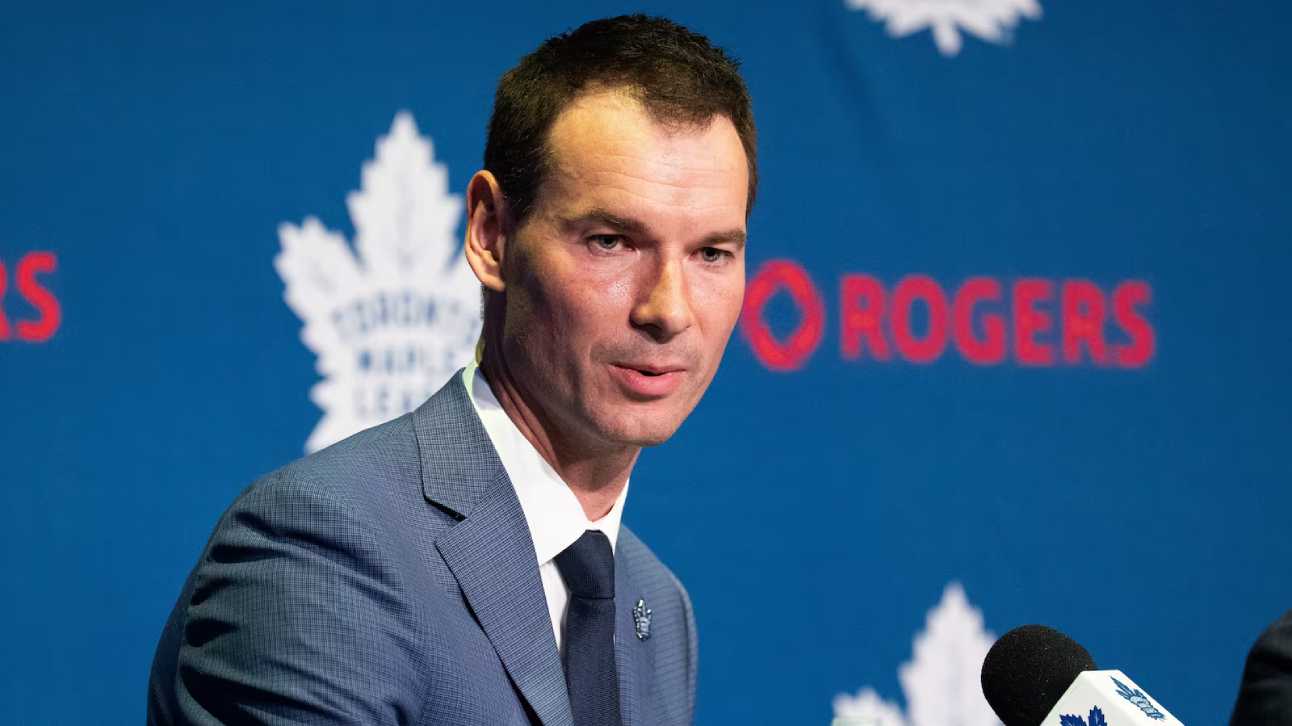
Toronto Maple Leafs general manager John Chayka says his team must improve defensively to reach its goals, and Monday night provided a timely reminder of why. Hours after the GM discussed Toronto’s blue line and the possibility of another trade, the Leafs lost 5-2 to the Calgary Flames on October 26, ending a four-game winning streak.
Speaking with reporters in Calgary, Chayka acknowledged the need for better defensive play while cautioning that another transaction is not automatically the answer. Sportsnet’s Luke Fox reported the comments before the game. Toronto then surrendered three goals before scoring one, watched rookie Easton Cowan take responsibility for costly mistakes, and lost winger Kirill Marchenko to a lower-body injury.
The real issue is bigger than finding a new defenceman. Chayka has already rebuilt much of the roster, and Toronto must decide whether its defensive problems come from the personnel, the system, or the adjustment period that follows substantial change. The next few games could tell him which problem is most urgent.
John Chayka Addresses the Maple Leafs’ Defensive Needs
Chayka’s message was more nuanced than a demand for immediate trade help. He acknowledged an obvious weakness but argued that defending is a five-player responsibility, involving decisions with the puck, forwards recovering into their own zone and players becoming more comfortable with coach Jim Hiller’s system.
As Chayka told Fox, “I don’t think a transaction is necessarily always the way to improve.” The GM nevertheless said Toronto will continue evaluating the market and remains willing to improve its lineup when an opportunity makes sense.
That distinction matters. Toronto’s recent four-game surge included a 7-2 victory over Edmonton on October 24. A team capable of that performance has reason to explore internal improvement before spending another premium asset. One result in Calgary should not erase a productive week, but neither should four victories hide recurring mistakes.
Chayka also indicated that salary-cap and contract-tagging considerations have not prevented the trade conversations Toronto has explored. That is a statement about the club’s perceived flexibility, not confirmation that a deal is imminent or that any particular target is available.
Enjoying our trade coverage? Add us as a preferred source on Google to catch breaking rumors first.
The Calgary Loss Showed Why Defence Is Still a Priority
The sequence was uncomfortable for the Leafs. Calgary built a 3-0 advantage early in the second period before Toronto responded with goals from Cowan and William Nylander. The final score looks more lopsided because the Flames added two empty-net goals, but the damage had already been done during Toronto’s slow start.
Cowan’s own-zone turnover helped set up Mikael Backlund’s first-period goal. The rookie then took a roughing penalty that led to Matvei Gridin’s power-play goal. Afterward, Fox reported Cowan’s candid assessment: “Bad turnover and dumb penalty by me.”
That accountability should not make Cowan the scapegoat. He also scored his sixth goal of the season and extended his point streak to four games, with three goals and three assists in that span. Hiller publicly defended the youngster after the loss. Toronto’s problems cannot be placed on a single 21-year-old winger.
My read: the most revealing problem was not that the Leafs allowed five goals; two were scored into an empty net. It was how quickly a turnover, a coverage lapse and an undisciplined decision changed the game. Those are precisely the details Chayka was describing when he said defending requires the entire unit.
The club’s response now matters more than the score. Does Toronto exit its zone with better support? Do the forwards arrive beneath the puck before opponents create a second chance? Can the Leafs avoid chasing games after poor first periods? Those answers will help determine whether a new defender changes the outcome or simply inherits the same problems.
What the Numbers Tell Us About Toronto’s Start
Toronto left Calgary at 7-5-2, with 16 points through 14 games. The defeat ended four consecutive victories, but the Leafs were competitive enough to cut a three-goal deficit to 3-2 before the empty-netters. It was a setback, not evidence of a collapsing season.
One important contrast: the Leafs went 0-for-2 on the power play and 5-for-6 on the penalty kill. That special-teams breakdown gives context to Gridin’s decisive goal without turning the entire loss into a verdict on the defensive corps. The team’s official recap also credits Auston Matthews with his 800th NHL point and notes Cowan’s continued offensive production.
A Defence Trade Is Possible — But the Asking Price Matters
There is a genuine trade angle here. Sportsnet’s Elliotte Friedman reported that Toronto would consider paying a premium price for a difference-making defenceman, but does not want to surrender its best assets for a short-term patch. Friedman also reported interest in the possibility of exchanging an older player for a younger one.
That is a sensible dividing line. If Chayka is prepared to move a valuable young player or premium pick, he should be targeting someone who changes Toronto’s defensive ceiling for multiple seasons. Acquiring a depth defender solely to survive a few difficult weeks would be a very different use of assets.
There is also a danger in reading every established defenceman’s name as an active trade negotiation. NHLTradeRumor.com’s recent look at a hypothetical Zach Werenski scenario explored what an elite addition could cost. It was not confirmation of talks, a formal offer or the availability of Werenski. Those distinctions matter when evaluating Toronto’s options.
My preference would be patience unless the opportunity is unusually strong. A good trade solves more than the next game. It improves matchups, withstands injuries and avoids compromising the younger talent Chayka is trying to develop.
Chris Tanev, Ben Danford and the Internal Options
Chris Tanev’s absence helps explain why the blue-line discussion is intensifying. The veteran defenceman participated in a team skate Monday in a non-contact jersey as he works back from an upper-body injury. Chayka described his progress positively but did not provide a firm return date.
Tanev’s eventual return could restore some of the defensive detail Toronto has been missing, particularly in coverage and puck retrievals. Yet relying on one veteran’s health to repair an entire structure would be a risky plan. A successful defence needs repeatable habits regardless of who is dressed.
Chayka also discussed Ben Danford, the 2024 first-round selection developing with the Toronto Marlies. Rather than rush the 20-year-old into a temporary opening, the GM emphasized the value of big AHL minutes and long-term readiness. That’s the right principle for a prospect whose potential career in Toronto matters more than a short-term reaction to one loss.
The active group, including Jake McCabe, Morgan Rielly, Darren Raddysh, Troy Stecher and Oliver Ekman-Larsson, has to stabilize its decisions while injured players recover. This is where coaching and roster construction intersect: more disciplined forward support can make an imperfect blue line look substantially better.
Easton Cowan and Gavin McKenna Are Part of the Answer
Chayka’s remarks about the young forwards reveal something important about his plan. He praised Cowan’s all-around development and defended Hiller’s decisions to limit Gavin McKenna’s minutes in certain defensive situations. In his view, an 18-year-old offensive talent still has to learn the responsibilities that come without the puck.
Monday showed both sides of that approach. Cowan made mistakes that mattered, but he answered with a goal and took ownership afterward. That is part of learning to handle difficult minutes, not automatically a reason to trade him or reduce his role. McKenna’s offensive creativity presents a related challenge: give him room to develop without asking him to master every late-game assignment immediately.
Chayka also declined to declare Cowan completely off-limits in a trade, while speaking enthusiastically about his value. That is not the same as saying Toronto is shopping him. A GM who keeps options open still needs to recognize the benefit of young players improving internally instead of buying every solution elsewhere.
For an organization with extensive roster turnover, continuity has value. Allowing McKenna and Cowan to build defensive trust beside experienced teammates could be one of the cheapest and most sustainable upgrades available.
What Happens Next for the Maple Leafs?
Toronto visits the Seattle Kraken on Wednesday, October 28. The immediate watch points are straightforward: fewer careless exits, better recovery by the forwards, and a more controlled opening period. Those are observable improvements that don’t depend on a trade announcement.
Health is the other variable. The Leafs need further clarity on Marchenko’s lower-body injury, Tanev’s practice progression and the timeline for other sidelined regulars. None should be assigned a speculative return date before the team provides one.
Meanwhile, Chayka can keep assessing the trade market without treating Calgary as an emergency. If an impact defenceman becomes available at an acceptable price, he has signalled a willingness to act. If not, Hiller’s system, the existing blue line and the development of Toronto’s young forwards must do the heavier lifting.
Final Take: The Maple Leafs Need More Than Another Defenceman
Chayka was right to identify defensive play as an unfinished part of Toronto’s rebuild. Calgary’s win made his comments look especially timely, but it did not prove a blockbuster is necessary.
The Maple Leafs need to distinguish between a roster weakness and a team-habit problem. A high-end defender could help with the first. Only sharper puck management, consistent support and smarter decisions will solve the second. That’s the standard Toronto should be judged against before Chayka pays a premium price.
Get the Latest NHL News
Follow the latest Toronto Maple Leafs news and trade rumors, injury updates and roster analysis at NHLTradeRumor.com. You can also revisit our analysis of Morgan Rielly’s future in Toronto.